


Etz Hayim means “Tree of Life” in Hebrew. The name comes from a verse sung in every synagogue when the Torah is returned to its place: “It is a tree of life to those who hold fast to it.” Many Sephardic synagogues across the Mediterranean carry this name, and the Etz Hayim of Izmir is widely believed to be the oldest of them all.
A Story That Begins Before the Ottomans
A remarkable document gives us a glimpse of the synagogue’s earliest days. Rabbi Avraham Ben Ezra, who died in 1761, recorded in his book Bate Kenesiot a responsum left by his grandfather, Rabbi Salomon Ben Ezra, who died in 1688. The grandfather wrote:
“There was once only one synagogue in Izmir. The Turks came and prayed there, and turned it into a mosque. The Jews could no longer pray inside it, and worshipped in the streets and outside the building. Then a man named Reuven built a new synagogue in his garden, and dedicated it to God.”
Historians believe this took place when Turkish forces first reached Izmir in the early fourteenth century, long before any mosques had been built in the city. The Jews of Izmir were left without a synagogue for many years, until Reuven opened his garden to the community.
The story does not end there. For generations, the community recited prayers in Reuven’s memory every year on the eve of Yom Kippur and on the night of Simchat Torah. When his children later sold the synagogue to the wider community, they did so on the condition that these prayers would continue forever.
Rebuilt After the Great Fire
Like most synagogues in Izmir, Etz Hayim suffered through many fires across the centuries. In the great fire of 1841, the building burned to the ground. Ten years later, a wealthy broker named Daniel de Sidi paid for it to be rebuilt. The structure we see today is the one he commissioned.
Visitors enter the synagogue by climbing a long staircase. There was once a smaller synagogue on the lower floor known in Ladino as Etz Hayim de Abasho, “Etz Hayim Below,” with the upper synagogue called Etz Hayim de Ariva, “Etz Hayim Above.” A small garden lies behind the building.
Inside the Synagogue
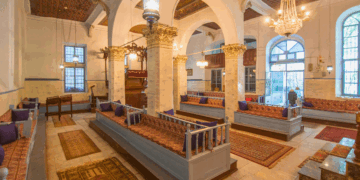
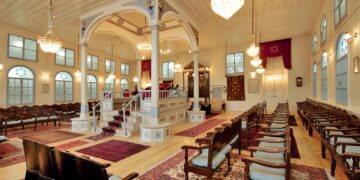
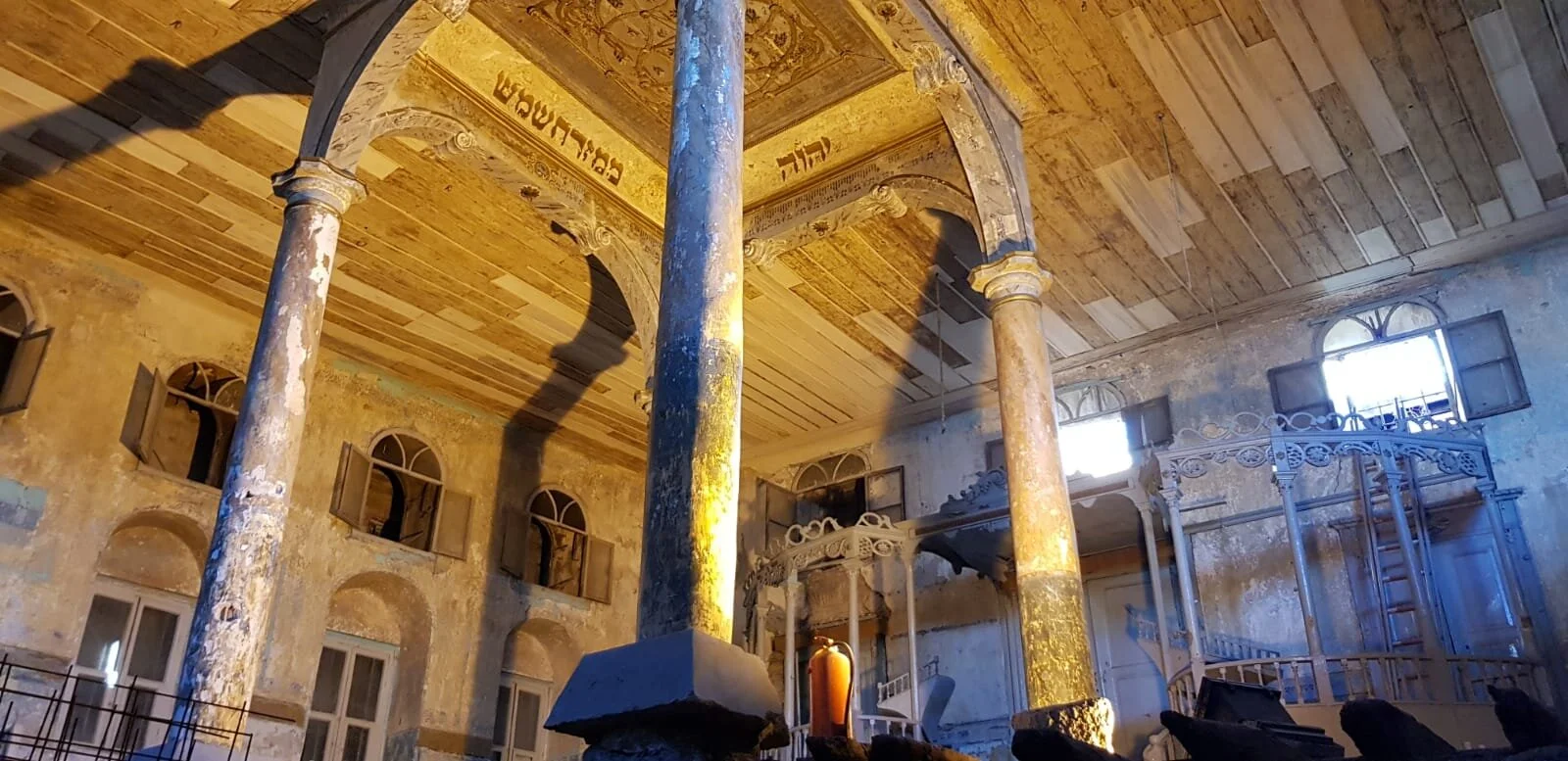
Etz Hayim follows the traditional Sephardic Anatolian plan, a layout shared with synagogues in Jerusalem, Salonika, and across the Sephardic world. The Tevah, the platform from which the Torah is read, originally stood at the center of the hall. Four columns rose around it, and long benches with simple cushions lined the walls. Painted decoration made the walls look like marble.
In the early twentieth century, following a fashion that came from European synagogue architecture, the Tevah was moved from the center of the hall to a position next to the Ehal, the cabinet that holds the Torah scrolls.
Among the families who prayed at Etz Hayim across the generations were the Hulli, Abulafya, Alfandari, Yafe, Hayim, Ginni, and Cimi families.
Saved from Collapse
By the late twentieth century, Etz Hayim was in serious danger. The roof was close to collapse, the marble floors were broken, and earthquakes had damaged the structure in many places.
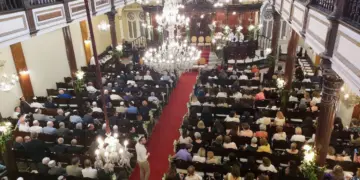
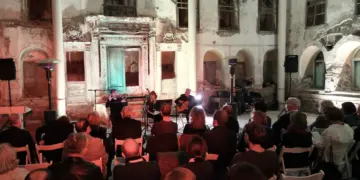
The rescue came thanks to a partnership between the Izmir Jewish Community, the Izmir Metropolitan Municipality, the Izmir Development Agency, and international supporters including the United States Ambassadors Fund for Cultural Preservation and the Kiriaty Foundation. After years of careful work, the fully restored Etz Hayim Synagogue was officially reopened on November 29, 2021.
The Meaning of the Name
The name Etz Hayim carries layers of meaning in Jewish tradition. Every Torah scroll is itself called a Tree of Life, and the wooden poles that hold the scroll are known as atzei chayim. In Kabbalah, the Tree of Life appears as the Sefirot, the diagram that maps the flow of divine energy through ten qualities such as wisdom, understanding, and beauty.
For the Jewish community of Izmir, the name carries one more meaning. After fires, earthquakes, conquests, and centuries of hardship, the Tree of Life of Izmir is still standing.