


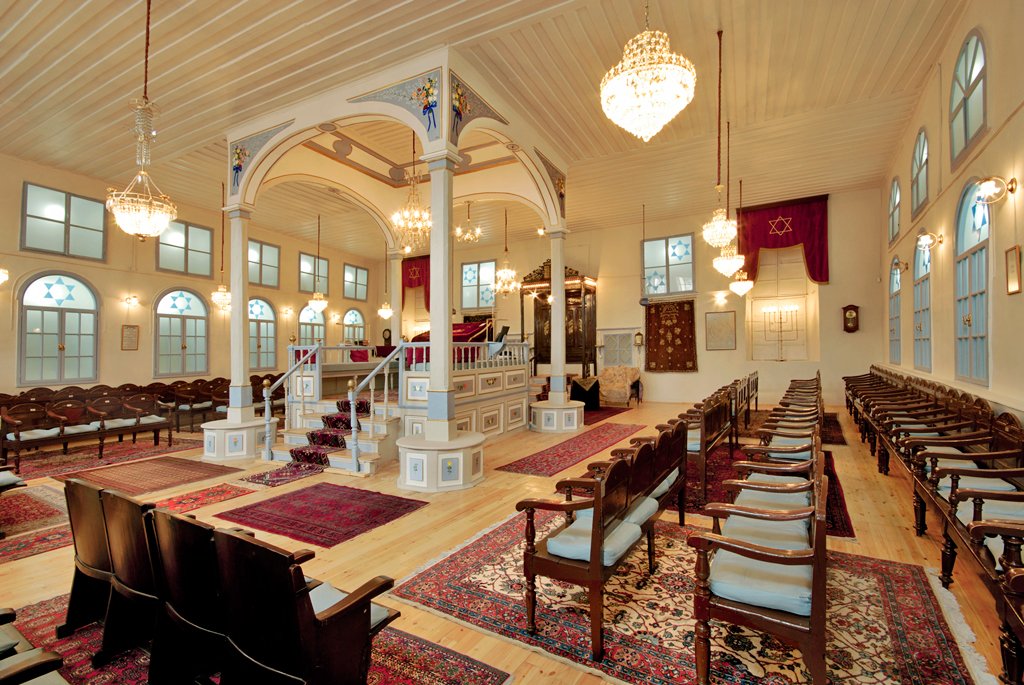
The Algazi Synagogue is one of the largest, oldest, and most beautiful surviving synagogues in Izmir. It carries the name of one of the city’s most distinguished families, a dynasty that for centuries gave Izmir its leading rabbis, scholars, and cantors. To step inside Algazi is to step into a space that has been at the heart of Izmir’s Jewish life for nearly four hundred years.
A Synagogue Named for a Family
The Algazi family’s roots in the Sephardic world stretch back to seventeenth century Bursa, where Rabbi Salomon Algazi was born in 1610. He studied in Gallipoli and Jerusalem before settling in Izmir between 1640 and 1642. From that moment on, generations of Algazis served as scholars, judges, theologians, and cantors. Their books are still read, and their voices, in the case of the family’s many cantors, are still remembered.
According to the inscription at the synagogue’s entrance, the building was constructed in 1724 by Ishak Algazi, who was known across Izmir as Dayan, the judge, because he settled the city’s commercial disputes. Some historians, however, believe a synagogue stood on this site even earlier, possibly as far back as the 1660s. There is a tradition that Sabbatai Zvi himself, the seventeenth century mystic who proclaimed himself the Messiah, may have prayed in the original building.
Behind the Iron Shutters
From the street, Algazi gives almost nothing away. A high wall and twelve old iron shuttered windows, arranged in two rows, hide the interior completely. The heavy nineteenth century wooden gate, with its rough carved stone frame, looks almost humble.
A small detail at the gate tells a story of Sabbath observance. A chain hangs through a small hole in the door. When pulled from outside, it rings a bell in the courtyard. This was the way visitors announced themselves on Saturdays, when religious law forbids the use of electricity, and therefore the use of an electric doorbell.
A vaulted brick passage leads inside. Beyond it, a courtyard floored in nineteenth century gray and black marble opens up. A marble staircase climbs to the upper synagogue, known in Ladino as Kal de Ariva, “the synagogue above.” On a wall in the courtyard, an old inscription records the date the building was raised.
A Synagogue Full of Stories
A long entrance corridor inside the synagogue holds two unusual local legends. Above this corridor, there once stood the azara, the women’s gallery. According to one story, during a Yom Kippur service, a young cantor was said to have winked at a woman in the gallery. From that day on, no woman was allowed to enter the synagogue, and the azara was eventually torn down.
Another story tells of a Sukkot festival when the synagogue’s wardens, the gizbarim, decided to skip the customary processions with the Torah scrolls in order to avoid the usual crowding. Within the same year, every warden involved in the decision had passed away. The rabbi of the time saw a vision in his sleep telling him that the processions must continue. From then on, everything returned to its proper order.
Inside the Main Sanctuary
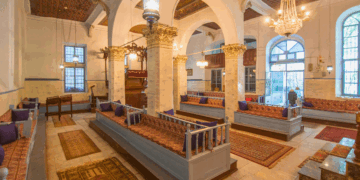
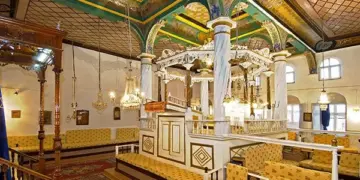
The main prayer hall is a square of about three hundred and fifty square meters. The Tevah, the platform from which the Torah is read, stands at the center. Four slender wooden columns rise around it, painted to resemble marble, set on heavy stone bases that mark out the central square of the hall. The arches above the Tevah were beautifully repainted in 2007 by Selma Arditi, an artist of the Izmir Jewish community.
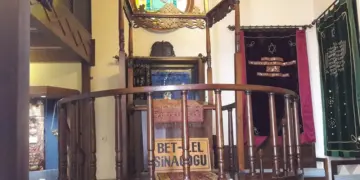
On the eastern wall stand three cabinets, in the traditional Sephardic Anatolian arrangement, with two smaller glass cabinets added to the sides. The central cabinet is the Ehal, where the Torah scrolls are kept. Its doors are carved with sacred Hebrew words in raised letters, and the cabinet is surrounded by tiny lights that seem to scatter a divine glow across the wall. Inside the Ehal, a list records the names of those who donated Torah scrolls to the synagogue. At its peak, Algazi held six Sefer Torahs.
The seats are mostly nineteenth century. Many of them carry raised Hebrew inscriptions naming the family or person to whom the seat belonged. Two seats have a particular weight of memory. Beside the Ehal, draped with a heavily embroidered parohet, is the Chair of Elijah the Prophet. On the other side of the Ehal stands the seat traditionally said to have been used by Chief Rabbi Avraham Palachi, one of the most important religious figures of nineteenth century Izmir.
The synagogue was the spiritual home of two unforgettable twentieth century figures: Chief Rabbi Moshe Melamed, and Avram Mizrahi, the beloved mohel who performed circumcisions for thousands of Izmir’s children across many decades.
A Family of Cantors
The Algazi family is celebrated above all for its cantors. For three generations the family produced hazanim whose voices defined the sound of prayer in Izmir.
The most famous of them was Ishak Ben Salomon Algazi, born in Izmir in 1889 and educated at Yeshiva Bet Hillel. Following his ancestors, he served as a cantor at the Algazi Synagogue, but his gift carried him far beyond it. He became one of the most important composers of religious, secular, and classical Turkish music of his time. Known as Neim Zemirot Yisrael, “the sweet singer of Israel,” he is remembered as one of the great voices of Ottoman and early Republican Turkish music. He died in Uruguay in 1950.
For thirty years in living memory, the cantor Leon Hakim served the Algazi Synagogue as a volunteer, leading prayers with a tenor’s voice and a deep knowledge of Jewish tradition. His son Yehiel stood beside him at the Tevah and carried the cantorial tradition forward. Both Leon Hakim and Yehiel are now remembered with deep affection by the community they served for so long.
Restorations and Renewal
Until 1907, when the Beit Israel Synagogue was built in Karataş, Algazi was the most important synagogue in Izmir. It was carefully restored in 1997 under the leadership of Salvator Eskinazi, with the work of Rafael Benveniste. A second major restoration followed in 2007, sponsored by the Eskinazi family in memory of Salvator Eskinazi and supported by many other donors.
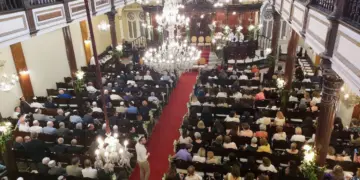
Thanks to a dedicated board and devoted yehidim (members), the synagogue remains open for prayer every Sabbath and holiday. Its beautifully preserved interior makes it one of the finest surviving examples of Ottoman Sephardic synagogue architecture in Turkey.