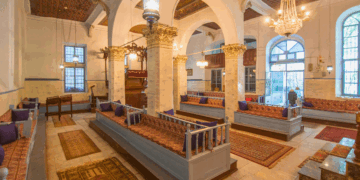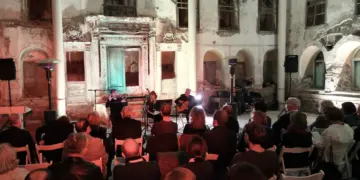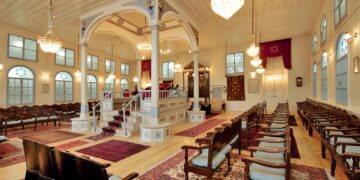



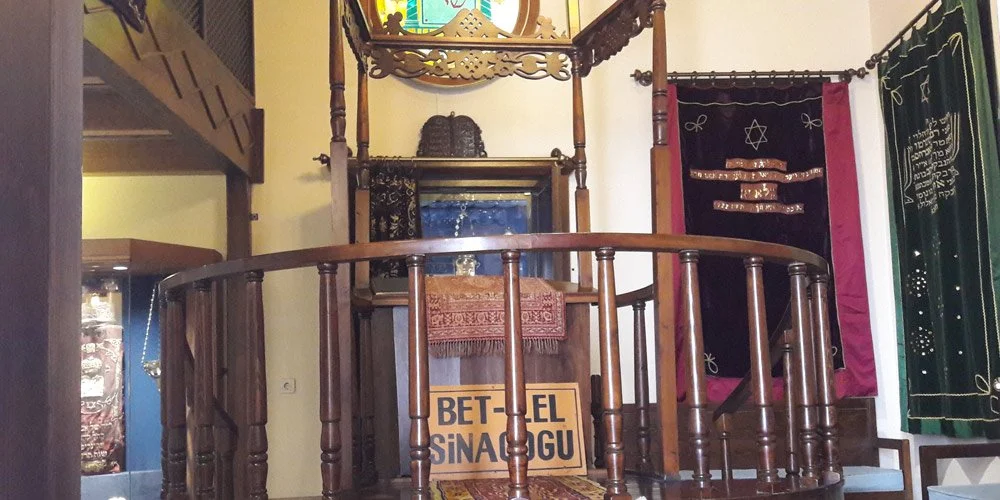
Bet Hillel is the smallest of the historic synagogues that still stand in Izmir’s old Jewish quarter. It is also one of the most cherished. The building began as a private home, became a place of religious study, and grew into a sanctuary that today welcomes visitors from around the world.
A House That Became a Place of Prayer
The building was originally part of the Palachi family home. It first served as a yeshiva, a religious school where Rabbi Hayim Palachi and later his sons studied for many years.
In 1840, Rabbi Avraham Palachi turned part of the family property into a small prayer house. For decades, the same walls served two purposes. They held a school for students of religious law and a place of worship for the family and its circle. This pattern, where a rabbinic household opened its doors as both a study hall and a synagogue, was common in Sephardic communities across the Ottoman world. The building remained in active use as a prayer house until the 1960s.
The synagogue takes its name from Eliezer Hillel Behor Manoah, a wealthy philanthropist from Bucharest. His donation paid for the construction of the building and also funded the publication of Rabbi Hayim Palachi’s books. The same gift helped repair two other Izmir yeshivot damaged in the great fire of 1841. Within the community, the synagogue was sometimes also called the Avraham Palachi Synagogue, after its founder.
A Long Period of Silence
After it closed as a place of worship in the 1960s, the building was used for many years as a storage depot. It was emptied in 1986. In 2006, a fire destroyed the roof and the interior. Only the front wall and parts of the side walls remained standing.
Rebuilt as a Memorial House
The building was rescued through a project of the Izmir Metropolitan Municipality called “Izmir Meets Its History.” The Izmir Jewish Community Foundation signed a protocol with the municipality, and the structure was carefully rebuilt.
The site reopened on April 24, 2017 as the Rabbi Hayim Palachi Memorial House.
Inside the Memorial House
Visitors today can explore a small Palachi Collection drawn from local and international archives. The collection includes photographs of Rabbi Palachi and his family, original letters in Ottoman Turkish and French written by the Chief Rabbi, and three original books printed in Salonika and Izmir, chosen from among Palachi’s seventy-two works. A historically important notebook once belonging to the synagogue is also on display, alongside selected Judaica objects and a short history of the building itself.
The Diamond Triangle
Bet Hillel forms one corner of what the disciples of Rabbi Palachi call the Diamond Triangle, known in Turkish as the Pırlanta Üçgen. This tradition belongs to a wider Sephardic practice of honoring the tombs and dwelling places of righteous sages, a custom that draws pilgrims to similar sites in Morocco, Tunisia, and Israel.
The Triangle is made up of three sacred sites in Izmir:
- Bet Hillel Synagogue, the spiritual home of the Palachi family
- The tombs of Rabbis Hayim and Avraham Palachi in Gürçeşme Cemetery
- The Mikveh built by their disciples at the cemetery. It is fed by a spring that flows down from Kadifekale. The water is said to run cool in summer and warm in winter, and many believe it has miraculous properties.
Every year, a group of about eighty to one hundred disciples travels from Israel to Izmir on the anniversary of Rabbi Avraham Palachi’s death. They come to pray at these three sites and to immerse in the mikveh. Today, the Diamond Triangle is an important destination for religious pilgrimage and a meaningful connection between the Jewish heritage of Izmir and the wider Sephardic world.