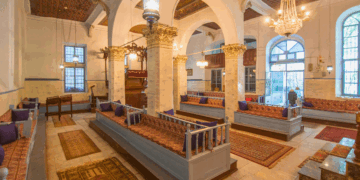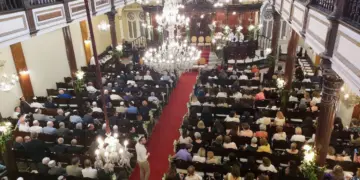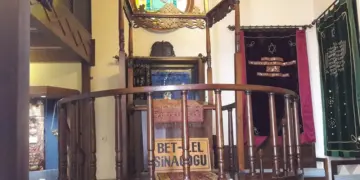



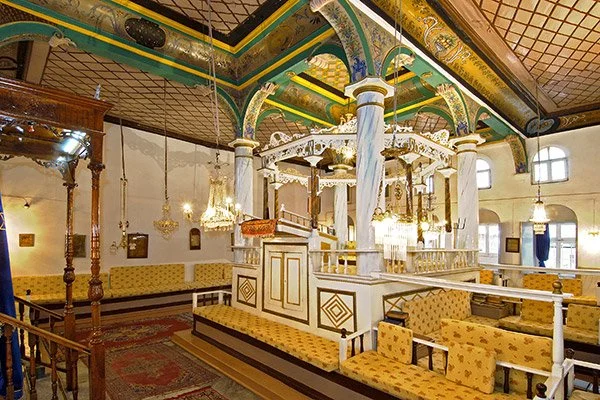
Bikur Holim is one of the most beautiful synagogues in Izmir. Its painted ceilings, its colorful columns, and its warm, welcoming atmosphere make it feel less like a formal house of prayer and more like a richly decorated Ottoman home. The name itself, Bikur Holim, means “Visiting the Sick” in Hebrew, and the synagogue carries a story of compassion that runs through every layer of its history.
A Gift from a Dutch Merchant
The story begins with a man named Salomon de Ciaves. His family had once been Conversos, Jews from Portugal forced to live as Christians, who later returned openly to Judaism after settling in Amsterdam. Salomon eventually moved to Izmir, where his family thrived as wealthy merchants.
In 1724, Salomon donated one of his courtyard houses to the Jewish community to be used as a synagogue. He did not stop there. He gave the neighboring houses and shops as well, so that their rents would provide a steady income for the synagogue. He also provided the Torah scrolls and all the sacred objects needed for worship. He asked for only one thing in return: that a member of his family always serve on the synagogue’s board.
A House of Healing
The name Bikur Holim reflects one of the most important values in Jewish tradition. Visiting the sick is considered a sacred duty, part of the highest form of kindness. Every major Jewish community has long maintained a Bikur Holim society. In Izmir, the society had been founded in 1642 by Chief Rabbi Joseph Escapa. When Salomon de Ciaves arrived from Amsterdam, he reorganized the Izmir society on the model he had known in the Netherlands.
The synagogue earned its name because its basement was used as a hospital during the plague and cholera epidemics that struck Izmir again and again. For many years, before formal Jewish hospitals existed in the city, this is where the community cared for its sick. Travelers who passed through Izmir in the eighteenth century wrote of a Jewish hospital in the city, and historians believe they were describing this very place.
There is also a quieter, sadder story attached to the basement. Some accounts say it once served as a small prison for the Jewish community.
Fire, Persecution, and Rebirth
The synagogue’s early decades were not easy. Salomon de Ciaves faced repeated complaints from people who objected to his house being used as a place of worship. After his death in 1745, his son Daniel de Ciaves rebuilt the synagogue and continued the fight to keep it open. In 1757, Daniel sent a petition directly to the Sultan, asking for protection from those who threatened him for hosting prayers and reading the Torah in his home. The Sultan responded with a decree in favor of the Jewish community.
In 1772, a great fire burned the synagogue to the ground, along with most other synagogues in the city. For twenty long years, Izmir was without a single working synagogue. Families rented houses and quietly turned them into places of prayer. Finally, in 1802, an Istanbul delegation led by Kamondo secured an imperial order allowing the synagogues to be rebuilt. Manuel de Ciaves, another member of the same family, restored Bikur Holim to the form we see today.
Inside the Synagogue
Bikur Holim is one of the finest surviving examples of Ottoman painted decoration in any synagogue. Visitors enter through an iron gate into a small courtyard, climb a few steps onto a veranda, and step first into the Bet Midrash, the study hall. Its marble floor, its Tevah marked with a great star at the center, and the benches lining its walls give the feeling of a small synagogue all on its own. On Sabbaths and holidays, members of the congregation gather here for breakfast after morning prayers.
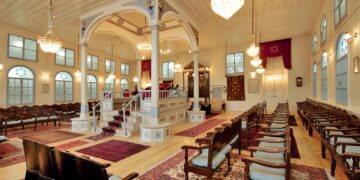
A door from the Bet Midrash leads into the main prayer hall, and the sight inside is unforgettable. The Tevah, the platform from which the Torah is read, stands at the center of the hall, raised on a wooden podium and surrounded by four columns. The lower parts of the columns and sections of the walls are painted to imitate marble. The ceiling is divided into panels filled with bright, hand painted kalem işi decorations. Tulips, roses, hyacinths, narcissi, curling leaves, and bowls of fruit cover every surface in the colors of an eighteenth century Ottoman palace.
Three cabinets stand against the eastern wall. The central one is the Ehal, where the Torah scrolls are kept, with two smaller cabinets for sacred books on either side. Velvet curtains called parohet hang in front of them. Twelve arched windows, in two rows of six, line the walls. The number is no accident. It represents the twelve tribes of Israel. The original nineteenth century iron shutters are still in place.
Above the entrance, reached by a separate staircase from the courtyard, is the women’s gallery known as the azara. In keeping with the customs of the time, it was once enclosed by latticed wooden screens, just like those in traditional Ottoman Turkish homes, so that the women inside could see the prayers below without being seen themselves.
The whole effect is striking. With its layout, its painted decoration, and its warm light, Bikur Holim feels like a beautiful Ottoman Turkish house that has been gently turned toward Jerusalem. It is one of the clearest reminders of how deeply the Jewish community of Izmir was woven into the life of the city.
A Living Tradition of Care
The Bikur Holim Society that gave the synagogue its name has continued its work for nearly four hundred years. In 1840, the society restored the walls of the Bahri Baba Cemetery. In 1893, a women’s branch was founded to care for the hundreds of impoverished Russian Jewish refugees who had arrived in Izmir. In 1903, when Edmond de Rothschild visited the city, he made a generous donation to the society’s work.
The values that gave Bikur Holim its name, compassion, hospitality, and care for the most vulnerable, still echo in the painted walls of this remarkable synagogue.