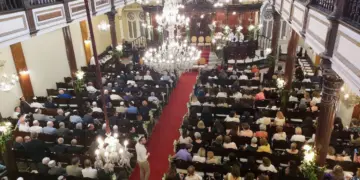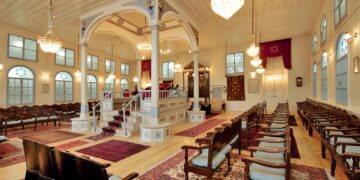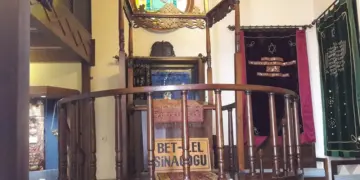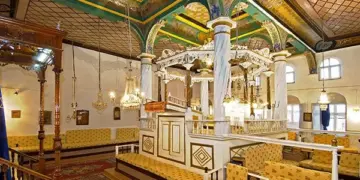



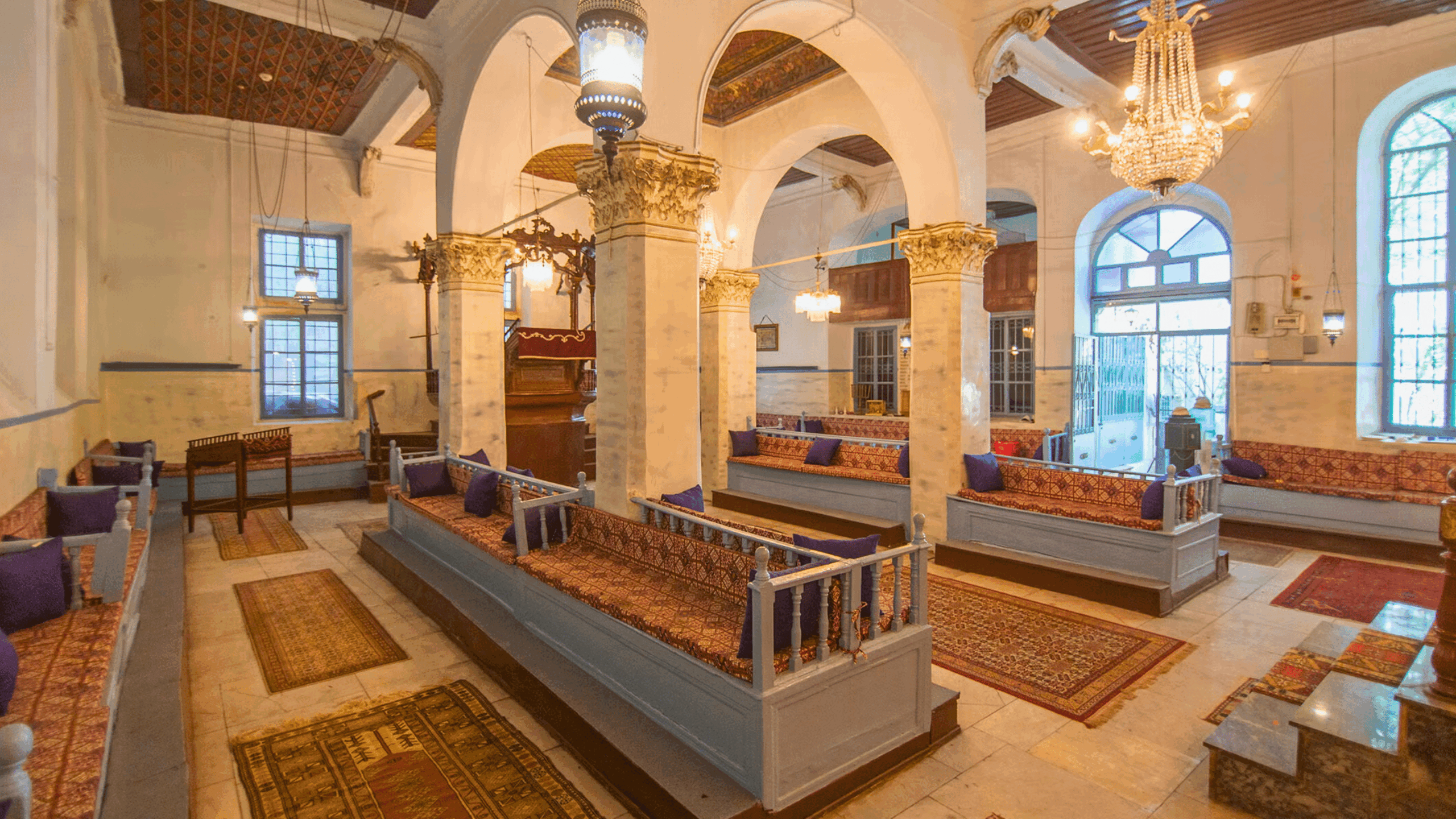
The Shalom Synagogue is one of the most authentic synagogues in Izmir. Its name means “Peace” in Hebrew, and stepping inside feels like entering a quiet Anatolian home rather than a formal house of worship. Hand carved ceilings, floral cushioned benches along the walls, and a Tevah shaped like the prow of a ship give Shalom a character all its own.
A Synagogue from the Earliest Days
Shalom is one of the oldest synagogues in Izmir, with roots reaching back to the 1640s. According to an inscription at its entrance, the building was rebuilt in 1800. It was founded by Jews of Portuguese origin, descendants of the Conversos who had fled the Inquisition and made their way through Europe before reaching Izmir. The synagogue is also known by a second name, Aydınlı, the “Synagogue of the People of Aydın,” for reasons we will return to later.
A recent discovery has added one more chapter to the synagogue’s story. Construction work has revealed that an Ashkenazi synagogue stood beside Shalom from the nineteenth century until perhaps the early twentieth. Almost no one in Izmir today remembers it. A small plaque now hanging on the garden wall of Shalom marks the place where it once stood.
The Synagogue of Rabbi Joseph Escapa
Shalom is forever linked to one of the giants of Izmir’s Jewish history: Rabbi Joseph Escapa (1570 to 1672). Born to a family that had fled Castile to Salonika, Rabbi Escapa moved to Izmir in 1620 and became, in 1648, the spiritual leader of the entire Jewish community of the city.
Under his guidance, Izmir grew into one of the most respected Jewish communities in the Ottoman Empire. He drafted the Takkanot, the community ordinances that organized taxation, settled disputes, and shaped daily life. Many of these rules are still in use in the Jewish community of Turkey today. He founded the Beit Din, the religious court, and the Konsilyo Komunal, the lay council. He also established the burial and care society known as Hevra Kedosha Shel Kabarim. The order he brought to community life made Izmir’s Jewish community a model that other cities looked to.
Rabbi Escapa is also remembered for one of the most dramatic episodes of seventeenth century Jewish history. He had been the teacher of the young Sabbatai Zvi, the man who would later proclaim himself the Messiah. When Sabbatai Zvi began to make his messianic claims, it was Rabbi Escapa who led the way in expelling him from Izmir.
The Miracle of 1841
In August of 1841, a great fire swept through Izmir and destroyed nearly every synagogue in the city. According to the community’s living memory, the flames stopped at the door of Shalom Synagogue. Where almost everything else burned, Shalom remained standing. The story of this miraculous escape is part of why Shalom is sometimes called the most authentic synagogue in Izmir. Much of what visitors see inside today truly belongs to an earlier age.
Inside Shalom
The interior of Shalom feels like a typical Anatolian house gently turned toward Jerusalem. The ceiling is decorated with carved wooden patterns and bright kalem işi paintwork. Long sofas with floral cushions line the walls, in the style of a traditional Ottoman parlor.
Although the synagogue was originally built on a central plan, in 1939 the Tevah, the platform from which the Torah is read, was moved from the center of the hall to the wall opposite the Ehal, the cabinet that holds the Torah scrolls. The Tevah itself is one of the most beautiful objects in Shalom. It is shaped like the prow of a ship, a quiet tribute to the boats that carried the Jews expelled from Spain to a new home in the Ottoman Empire.
Velvet parohet curtains hang above the sacred cabinets, including one that carries the date 5660, corresponding to 1900, and the name of Moshe Malki. The walls themselves hold old handwritten texts, including, on the right wall, the prayer recited by the Cohanim as the Torah is taken out of the Ehal.
A small garden lies behind the synagogue. The original well still stands there, alongside an old lamp and an inscription on the wall.
The earliest yehidim, the families who long made up the synagogue’s congregation, were the Malki, Russo, Yakoel, Benezra, Sadi, Almoslino, and Ganon families.
The People of Aydın
The second name of the synagogue, the Aydınlı, comes from a tragic chapter of the early twentieth century. The town of Aydın, ancient Tralles, had been home to a Jewish community since Roman times. By 1904, three thousand Jews lived there.
When Greek forces occupied Izmir and its surroundings in 1919, Aydın fell with them. In 1922, as the Turkish army recaptured the city, the retreating Greek forces set Aydın on fire. The Jewish community of Aydın lost everything. Some moved to Rhodes, others all the way to Buenos Aires and Montevideo, and a substantial group made their way to Izmir.
The Izmir Jewish community gave the newly arrived Jews of Aydın a spiritual home: the Shalom Synagogue. From that day forward, Shalom was also known as the Aydınlı. The Russo and Malki families, both of Aydın origin, led the synagogue until it closed for daily worship in 1998.
A Careful Restoration
In 2005, the World Monuments Fund made a major donation toward the repair of Shalom’s roof. The children of the synagogue’s old families, joined by many other supporters, came together to fund a beautiful and careful restoration. The work was led by community president Jak Kaya and his board, with the guidance of Prof. Dr. Eti Levi and Murat Özdemir, and the contributions of Sara Pardo and Selma Şen. A marble plaque on the wall lists the names of every donor who helped bring Shalom back to life.
Today Shalom remains one of the most beloved synagogues in Izmir, a quiet, warm, and deeply authentic space where centuries of Jewish life in the city are still gently held.